
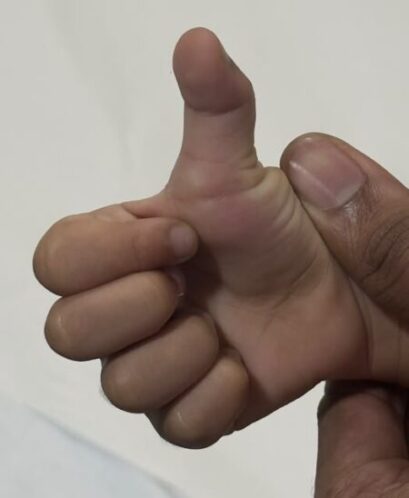
Is Your Toddler’s Thumb Stuck? A Parent’s Guide to Pediatric Trigger Thumb
If your toddler cannot fully straighten their thumb, keeps it tucked tightly into their palm, or you hear a distinct "click" when they try to extend it, they may have pediatric trigger thumb.
While finding your child's thumb locked can be alarming, this developmental condition is common, usually painless, and highly treatable.
What is Pediatric Trigger Thumb?
Pediatric trigger thumb is a developmental condition where a child’s thumb gets locked in a bent position. It typically appears between 1 and 3 years of age, and in about 25% of cases, it affects both thumbs.
- The Cause: A small, harmless bump called a Notta’s nodule forms on the thumb's flexor tendon.
- The Problem: As the tendon moves, this small nodule gets caught on the tight fibrous sheath (the A1 pulley) at the base of the thumb, preventing the tendon from sliding smoothly.
4 Common Signs of Trigger Thumb in Toddlers
Parents often notice signs during daily activities like eating, dressing, or playing with toys:
- Locked Thumb: The top joint of the thumb is bent toward the palm and cannot straighten on its own.
- Clicking or Popping: A distinct snap or click sound when your child attempts to extend the thumb.
- Small Lump in Palm: A firm, pea-sized nodule felt at the base of the thumb in the palm.
- Assisted Straightening: Your child uses their opposite hand to manually push the bent thumb straight.
How Is Pediatric Trigger Thumb Treated?
A pediatric orthopedic specialist can quickly diagnose this condition with a brief physical exam—x-rays or complex imaging are rarely needed. Treatment depends on your child's age and the severity of the flexed joint.
1. Non-Surgical Treatment (Under Age 2)
For infants and younger toddlers with mild or flexible cases, doctors usually recommend conservative management first:
- Observation: Up to 30% to 60% of mild cases in younger children resolve naturally over time.
- Stretching & Splinting: Gentle daily stretching exercises or wearing a custom nighttime splint helps keep the thumb in a functional, straight position.
2. Surgical Release (Over Age 2)
If the thumb remains locked past age two or conservative management does not help, an outpatient procedure called an A1 pulley release is the definitive fix:
- The Procedure: Performed safely under general anesthesia, the surgeon makes a tiny incision to open the tight pulley tunnel so the tendon slides freely.
- Recovery: The procedure takes only a few minutes, and your child goes home the same day. Most toddlers return to normal, unrestricted play within 1 to 2 weeks.
When to See a Doctor
If you notice your child's thumb is bent, stiff, or clicking, schedule an evaluation with a pediatric specialist. Early assessment ensures you receive proper guidance on conservative care and helps your little one return to restriction-free play quickly.